
Below-average rainfall across most of Ivory Coast’s cocoa-growing regions is threatening the development of the mid-crop due to be harvested from July to August, raising fresh concerns about supply tightness in the world’s largest cocoa-producing nation.
Farmers in multiple regions reported that insufficient moisture — combined with persistently high temperatures — is already affecting developing pods, with some warning that without abundant rainfall before mid-May, the upcoming harvest could yield small, low-quality beans that would fetch lower prices on international markets.
Ivory Coast is in its rainy season, which runs from April through mid-November, and mid-crop harvesting was expected to intensify this month with robust volumes. But weather patterns have disappointed farmers across the country’s key cocoa belt.
## Parched Fields, Withering Pods
The trees need more water to grow well, said Leopold Kamenan, who farms near Abengourou in eastern Ivory Coast, where only 18.1 mm of rain fell last week — 6 mm below the five-year average for that period. Similar shortfalls were reported in the southern regions of Agboville and Divo.
In the west-central region of Daloa and the central region of Bongouanou — two of Ivory Coast’s most important cocoa zones — farmers said the prolonged dry spell is already affecting bean size. If there is not enough rain, the beans will be very small and of poor quality, said Albert N’Zue, a farmer near Daloa, where rainfall measured 16.4 mm last week, 5.2 mm below the seasonal average.
Only the western region of Soubre and the central region of Yamoussoukro saw above-average rainfall last week, providing some relief to farmers there.
## Climate Pressures Mount
Weekly average temperatures across Ivory Coast last week ranged from 28.3 to 32.2 degrees Celsius — at the higher end of the seasonal norm and compounding the stress on cocoa trees already struggling with insufficient moisture.
Ivory Coast’s cocoa sector accounts for roughly 40 percent of national export earnings and employs millions of smallholder farmers across the country’s rural south and west. Any meaningful disruption to the mid-crop could have ripple effects on global cocoa prices, which have already experienced significant volatility in recent years due to weather disruptions and disease outbreaks across West Africa.
## Farmers Hold Hope for Better Rains
Despite the dry conditions, some farmers said there was still time for the weather to turn favorable if rains arrive in earnest before mid-May. We need plenty of rain from now on, otherwise the mid-season crop will be short and of poor quality, one farmer near Soubre told Reuters.
The government and agricultural extension services have been working to promote climate-resilient farming practices, including shade management and improved soil moisture techniques, but many smallholder farmers lack access to these tools.
For now, all eyes are on the sky. The fate of Ivory Coast’s 2026 mid-crop — and the livelihoods of the millions who depend on it — rests on whether the rains come soon enough.
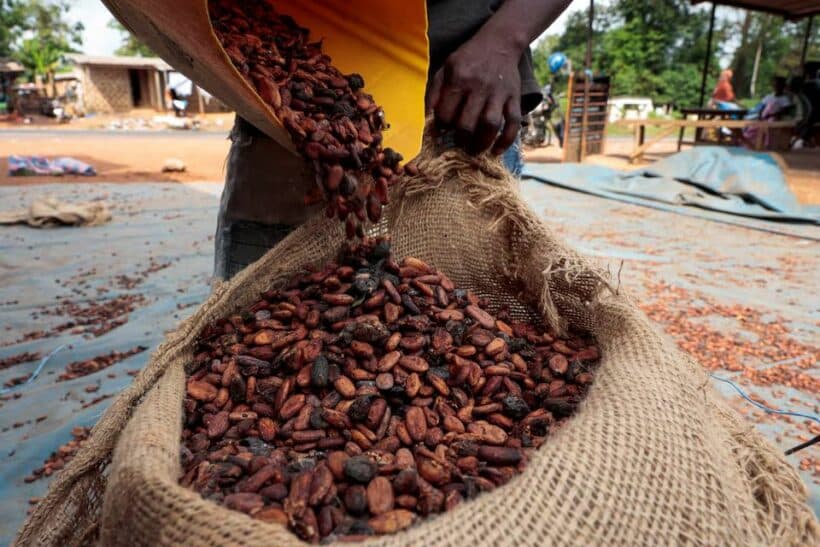
Image: A worker fills a sack with cocoa beans at a warehouse in Fengolo, Ivory Coast. Credit: Reuters / Luc Gnago