
Africa Now Has Its Own Credit Rating Agency. The Hard Part Starts Here.

The Africa Credit Rating Agency, launched in Mauritius on 7 October, is the continent’s boldest attempt yet to challenge the “prejudice premium” it says inflates its borrowing costs. But an agency created by the borrowers it will grade faces one test above all others: being believed.
Analysis — Now in Africa Staff, 14 October 2026
For almost a decade, the idea circulated in African Union communiqués and finance-ministry speeches. On 7 October 2026, it finally became an institution. The Africa Credit Rating Agency (AfCRA) was formally inaugurated at Balaclava, on the northern coast of Mauritius, with its headquarters in Port Louis and regional subsidiaries planned across the continent.
AfCRA is mandated by the African Union but deliberately structured as an independent, private-sector-driven institution. It will rate far more than governments: sovereign states, companies, subnational borrowers and public institutions all fall within its remit. The African Peer Review Mechanism (APRM) spent years on the consultations and technical groundwork, the UN Economic Commission for Africa (ECA) has backed the project, and the South African research firm Plus94 supported its technical establishment. Its stated ambition is not to replace S&P Global, Moody’s and Fitch, but to sit alongside them — an additional, Africa-focused assessment of repayment risk, built by people who argue that the incumbent trio systematically misunderstands the continent.
The grievance, in numbers
African governments have complained about credit ratings for years. What has changed is the price tag attached to the complaint.
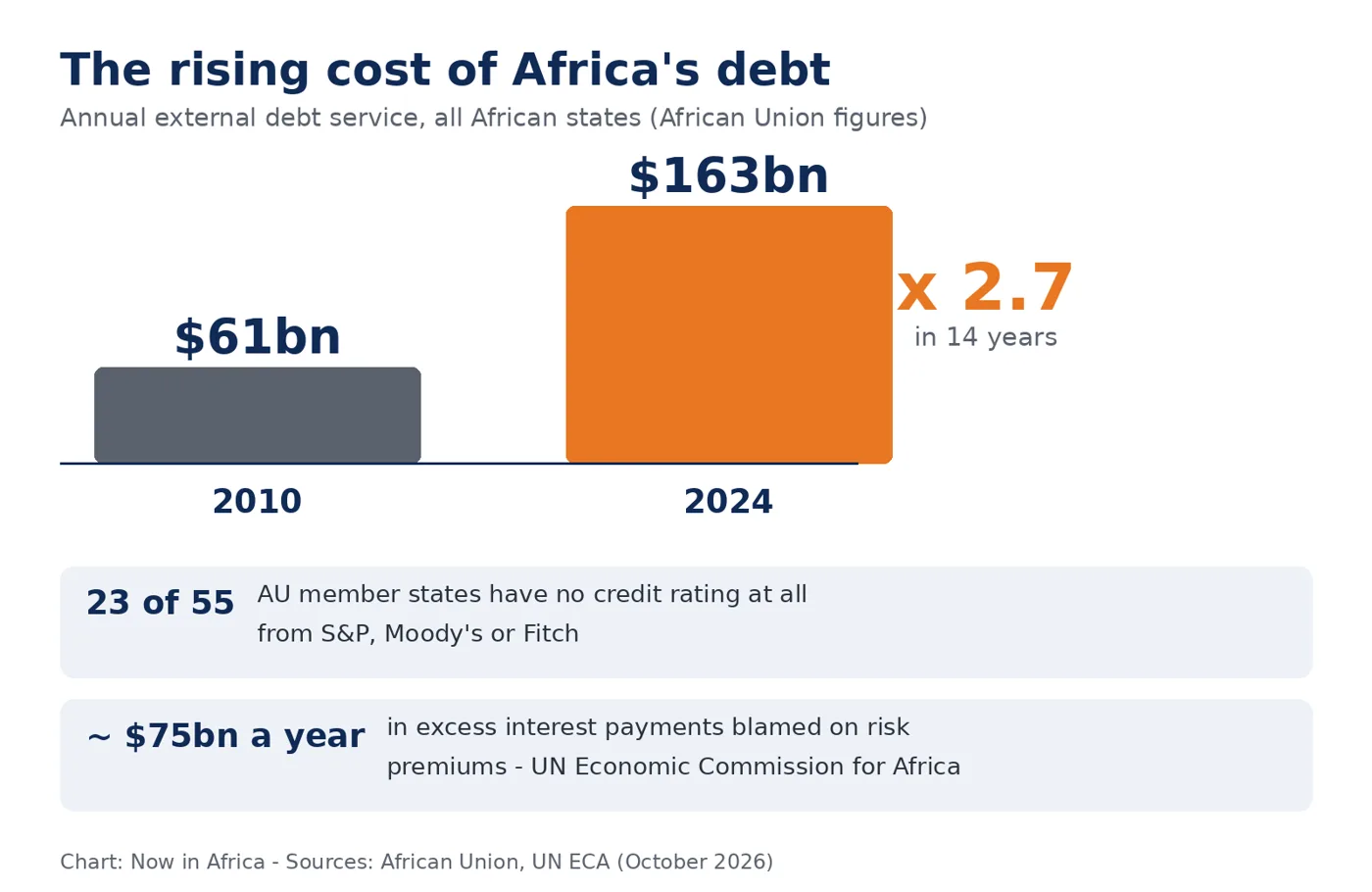
According to figures cited by the African Union at the launch, the continent’s annual external debt service climbed from $61 billion in 2010 to $163 billion in 2024 — a near-tripling in fourteen years, swollen by the borrowing of the pandemic era and the strong dollar that followed. Every fraction of a percentage point added to Africa’s borrowing costs is now measured in billions that cannot be spent on power plants, ports or hospitals.
Two further figures frame the argument. First, 23 of the African Union’s 55 member states have no credit rating at all from the three major agencies. Unrated borrowers are not necessarily risky borrowers; they are unknown ones, and unknown is expensive. When they do access markets, they pay for the absence of information. Second, Hanan Morsy, Deputy Executive Secretary of the UN ECA, told the launch that persistent risk premiums cost Africa an estimated $75 billion a year in excess interest payments — money paid not because projects failed, but because investors priced a perception.
This is the “prejudice premium” AfCRA was created to attack: the claim that ratings for African borrowers embed assumptions — about institutions, informality, commodity dependence — that are not applied with the same severity elsewhere, and that downgrades during crises have repeatedly overshot, cutting countries off from capital at the precise moment they most needed it. Ghana and Zambia are among the states that have protested most loudly after downgrade cycles that preceded their debt restructurings.
The big three agencies reject the charge. Their position, restated for years, is that they apply consistent methodologies worldwide and that African ratings reflect measurable fundamentals: debt ratios, revenue collection, reserve levels. On the narrow facts, they are often right. Most African sovereigns that ran into trouble after 2020 genuinely had stretched public finances. The argument was never really about whether the numbers were bad. It is about whether the lens adds a penalty of its own.

What AfCRA says it will do differently
AU Commission Chairperson Mahmoud Ali Youssouf set out four objectives at the launch: build African rating capacity and expertise; understand the real potential of African economies more deeply; assess their risks objectively; and contribute to the institutions shaping the continent’s capital markets.
Read closely, that list contains both the promise and the problem. “Understanding the potential” of African economies is where AfCRA claims its edge: analysts who know that a large informal sector is not automatically a fiscal black hole, that remittance flows stabilise external accounts in ways standard models underweight, that a regional power pool or a new port changes a small economy’s prospects faster than annual data can capture. Context, in other words, treated as information rather than noise.
Serving the unrated 23 is the clearest early win available. A credible first rating for a country that has never had one — even a modest one — can open conversations with investors that today never start. The same applies to African companies and municipalities, most of which have never been rated by anyone and therefore borrow, if at all, at punishing local rates.
The credibility test
Here is the difficulty no launch ceremony can dissolve. AfCRA was created by the African Union, championed by African governments, and exists because those governments dislike the grades they currently receive. Every favourable rating it issues will be read through that fact.
Credit ratings are a trust business. A rating only lowers a borrower’s costs if the lender believes it — if pension funds, banks and bond investors treat it as an honest signal rather than a diplomatic courtesy. That belief is earned slowly, in the least glamorous way possible: by publishing methodologies in full, by downgrading friends when the data demands it, and by being right, visibly and repeatedly, about defaults and recoveries. The first time AfCRA assigns a flattering grade to a state whose finances then collapse, the “prejudice premium” argument dies with it — because the market will conclude that the premium was never prejudice, just pricing.
Youssouf himself seemed keenly aware of this at the launch. He described AfCRA as part of a broader push for African financial sovereignty, then immediately lowered the temperature: a rating agency, he cautioned, “will certainly not significantly reduce the cost of capital in the near future”, and deeper reforms of the global financial system would still be needed. It was an unusually sober note for an inauguration, and probably the most important sentence spoken there.
Morsy made the complementary point from the other direction: ratings follow fundamentals. Sound macroeconomic management, disciplined fiscal policy, better domestic revenue collection and — a recurring African weakness — reliable, timely economic data will do more for borrowing costs than any new letterhead. An agency can describe an economy more fairly. It cannot make the economy safer than it is.

What to watch
Three things will tell us, within AfCRA’s first two years, whether it is becoming an institution or remaining a statement.
The first ratings. Whom AfCRA rates first, how its grades compare with the big three on the same borrowers, and how much daylight it puts between itself and them will set its reputation. Modest, well-documented differences will persuade; systematic generosity will not.
Regulatory recognition. Ratings matter most when rules depend on them — when central banks, pension regulators and banking supervisors accept AfCRA grades for capital and investment decisions. Recognition inside Africa would give the agency a real market even before global investors are convinced.
Coverage of the unrated. If AfCRA’s map fills in the 23 blank countries with serious, data-backed assessments, it will have done something the incumbents never bothered to do, and the continent’s smaller economies will feel it first.
None of this will show up in borrowing costs this year, and the AU, to its credit, is no longer pretending otherwise. But the significance of 7 October should not be understated. For decades, Africa’s place in global finance was described by three firms in New York and London, and the continent’s only options were to argue or to pay. It has now built the beginnings of a third option: describe itself, rigorously, and accept the discipline that being believed requires. Whether AfCRA can survive its own founding contradiction — created by borrowers, obliged to judge them — is the story to follow.
Sources: African Union and African Peer Review Mechanism statements at the AfCRA launch, Balaclava, 7 October 2026; UN Economic Commission for Africa remarks reported at the launch; Reuters reporting via Business Day and TimesLive (8 October 2026); Nairametrics (8 October 2026). Photographs via Wikimedia Commons under the licences noted.