
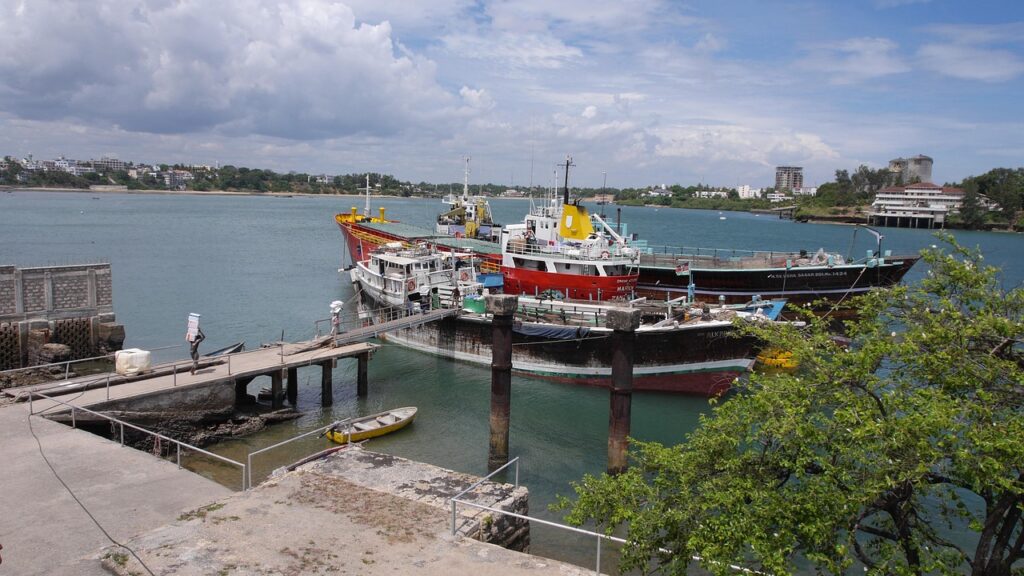
As the Strait of Hormuz finds itself at the heart of hostilities between Iran, the United States, and Israel — cutting off a critical portion of global trade from its most strategic maritime corridor — Kenya is discovering an unexpected upside. Its deep-water port of Lamu is rapidly emerging as a major logistics hub, rewriting its role in international shipping routes seemingly overnight.
From Underutilized Project to Sought-After Infrastructure
Opened in 2021 as part of the LAPSSET corridor program (Lamu Port-South Sudan-Ethiopia Transport Corridor), the port of Lamu struggled for years to establish itself on global trade routes. Poorly connected to the Ethiopian hinterland by incomplete land infrastructure, it had until recently attracted only limited maritime traffic.
But since the intensification of Middle Eastern conflict and the partial closure of the Gulf, international shipping companies have been rerouting vessels toward the Indian Ocean. Lamu port, which offers sufficient draft depth to accommodate large-capacity ships, has seen activity surge in just a matter of weeks. The Italian shipping carrier Grande Florida Palermo recently unloaded vehicles at Lamu — a first for a vessel of that size at the facility.
Ethiopia as the Natural Hinterland
Lamu primary asset remains its potential to serve landlocked Ethiopia, a country of more than 120 million people with severely limited sea access. The LAPSSET corridor envisions eventually building an oil pipeline and railway connecting Lamu to Addis Ababa. While these infrastructure projects remain unfinished, current geopolitical pressures are intensifying calls to accelerate their completion.
Nigeria, for its part, is also seeking to seize the moment. Nigerian Foreign Minister Yusuf Tuggar suggested his country aims to become an alternative petroleum supplier for traditional Middle Eastern markets, boosting Nigerian refining capacity in the process — exemplified by the Dangote refinery, which has already begun its first fuel exports to the continent.
A Temporary Boost or a Lasting Transformation?
For Kenya, the critical question is whether this surge in activity will prove durable. Experts consulted by The Africa Report urge caution: Lamu port will only maintain its attractiveness if land connections to the hinterland are modernized. The Kenyan government has pledged to accelerate LAPSSET corridor work, with total project costs estimated in the billions of dollars.
In the meantime, Lamu is already writing its own success story — that of a project born from geopolitics that could genuinely reshape the economic landscape of northern Kenya.
Source: The Africa Report