
Soldiers on the Cape Flats: South Africa Deploys 800 Troops to Fight Crime in Townships

CAPE TOWN, South Africa — Around 800 South African National Defence Force soldiers have been deployed to some of Cape Town’s most crime-affected townships as part of a broader national security strategy to combat surging gang violence and violent crime. The deployment, which officially began on April 1, 2026, represents one of the most significant military call-outs in the Western Cape in recent memory and has drawn mixed reactions from communities long accustomed to state neglect.

The soldiers, working in coordination with the South African Police Service and the City of Cape Town’s safety initiatives, are expected to focus on high-crime corridors in the Cape Flats — a vast expanse of township communities where decades of apartheid-era spatial planning left deep legacies of poverty, unemployment, and institutional abandonment. The area has long been among the most violent in South Africa, with murder rates that regularly exceed national averages by wide margins.

The Cape Flats Safety Forum, a community-based body representing several affected neighbourhoods, cautiously welcomed the deployment while expressing skepticism about its long-term sustainability. “We have seen soldiers here before, during xenophobic violence, during load-shedding emergencies, and during national disasters,” said a spokesperson. “What we have not seen is a lasting solution. We need this deployment to come with a real plan, not just a visible presence.”

South Africa’s crime crisis has deepened markedly over the past two years, driven by a combination of economic stagnation, the collapse of rehabilitation and parole systems, and the infiltration of criminal networks into community-level policing. Official statistics show that contact crimes — murder, attempted murder, sexual offences, and assault — have all risen year-on-year, with the Western Cape recording some of the highest per-capita murder rates in the country.

The deployment falls under a broader national security framework that allows for the temporary incorporation of military personnel into domestic law enforcement operations when deemed necessary by the President. Critics have warned that such deployments can blur the lines between military and police functions and risk human rights violations if proper oversight mechanisms are not in place.

Civil society organizations in Cape Town have called for transparent monitoring of the deployment, including clear chains of command, rules of engagement, and accountability mechanisms for any complaints. The South African Human Rights Commission has said it will be observing the operation closely.

For residents of the Cape Flats, the arrival of soldiers is simultaneously a sign of state engagement and a reminder of how deep the crisis has become. Whether a military presence can accomplish what decades of policing, development programmes, and community initiatives have failed to achieve remains to be seen — but for many, the hope is that this time, the intervention will be different.

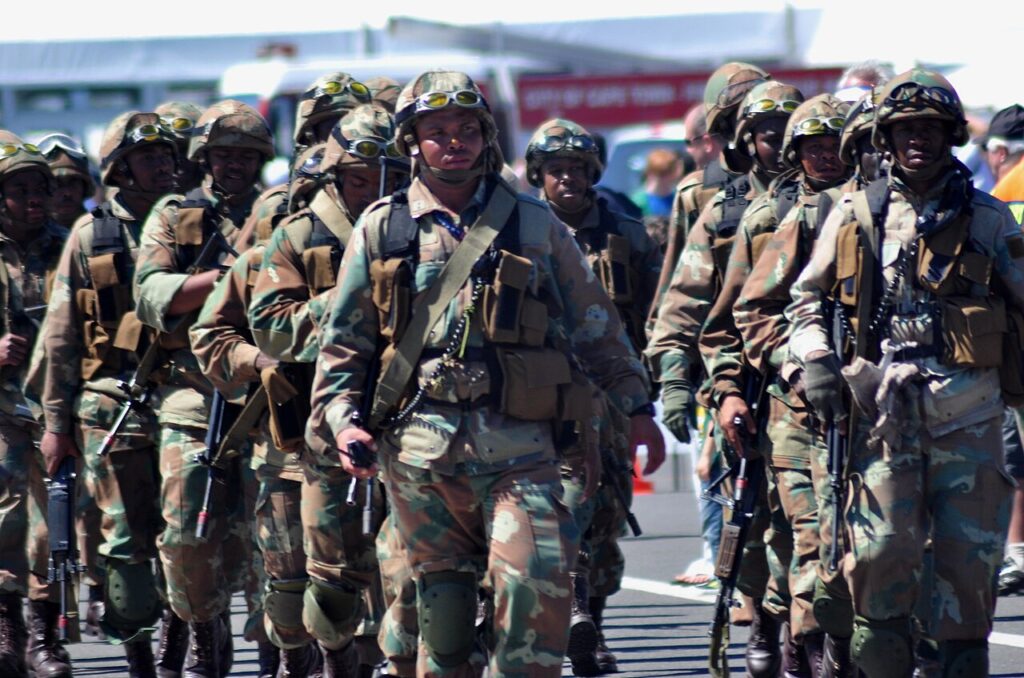
Image: South African soldiers. Photo via Wikimedia Commons (CC BY-SA).
Soldiers on the Cape Flats: South Africa Deploys 800 Troops to Fight Crime in Townships

CAPE TOWN, South Africa — Around 800 South African National Defence Force soldiers have been deployed to some of Cape Town’s most crime-affected townships as part of a broader national security strategy to combat surging gang violence and violent crime. The deployment, which officially began on April 1, 2026, represents one of the most significant military call-outs in the Western Cape in recent memory and has drawn mixed reactions from communities long accustomed to state neglect.

The soldiers, working in coordination with the South African Police Service and the City of Cape Town’s safety initiatives, are expected to focus on high-crime corridors in the Cape Flats — a vast expanse of township communities where decades of apartheid-era spatial planning left deep legacies of poverty, unemployment, and institutional abandonment. The area has long been among the most violent in South Africa, with murder rates that regularly exceed national averages by wide margins.

The Cape Flats Safety Forum, a community-based body representing several affected neighbourhoods, cautiously welcomed the deployment while expressing skepticism about its long-term sustainability. “We have seen soldiers here before, during xenophobic violence, during load-shedding emergencies, and during national disasters,” said a spokesperson. “What we have not seen is a lasting solution. We need this deployment to come with a real plan, not just a visible presence.”

South Africa’s crime crisis has deepened markedly over the past two years, driven by a combination of economic stagnation, the collapse of rehabilitation and parole systems, and the infiltration of criminal networks into community-level policing. Official statistics show that contact crimes — murder, attempted murder, sexual offences, and assault — have all risen year-on-year, with the Western Cape recording some of the highest per-capita murder rates in the country.

The deployment falls under a broader national security framework that allows for the temporary incorporation of military personnel into domestic law enforcement operations when deemed necessary by the President. Critics have warned that such deployments can blur the lines between military and police functions and risk human rights violations if proper oversight mechanisms are not in place.

Civil society organizations in Cape Town have called for transparent monitoring of the deployment, including clear chains of command, rules of engagement, and accountability mechanisms for any complaints. The South African Human Rights Commission has said it will be observing the operation closely.

For residents of the Cape Flats, the arrival of soldiers is simultaneously a sign of state engagement and a reminder of how deep the crisis has become. Whether a military presence can accomplish what decades of policing, development programmes, and community initiatives have failed to achieve remains to be seen — but for many, the hope is that this time, the intervention will be different.

Image: South African soldiers. Photo via Wikimedia Commons (CC BY-SA).