
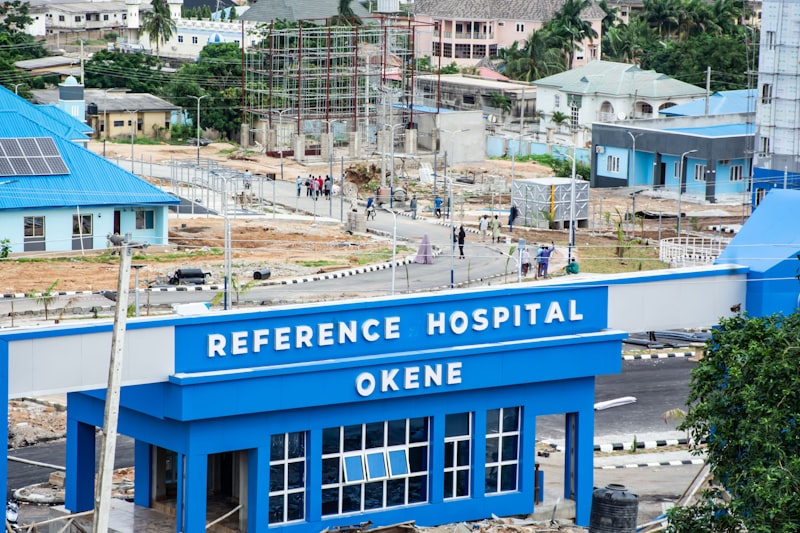
Nigeria’s already fragile healthcare system suffered another severe shock this week as the National Association of Resident Doctors (NARD) commenced an indefinite strike, citing chronic underfunding, unpaid salaries stretching back six months, and what they describe as a government failure to address the structural collapse of the country’s public health infrastructure. The strike, which affects teaching hospitals in all 36 states, comes at the worst possible time: the country is simultaneously battling a rise in infectious disease outbreaks, a brain drain that has emptied the country of experienced specialists, and an economy still absorbing the shocks of fuel subsidy removal.
The Federal Ministry of Health has called the strike unconscionable and asked the courts to declare it illegal. NARD has refused to budge.
**A System Already on Its Knees**
Nigeria’s public healthcare system has been underfunded for decades, with total health expenditure hovering around 3-4% of GDP—well below the African Union’s recommended 15% and far below the 15% Abuja Declaration benchmark that Nigeria signed onto in 2001. Successive governments have announced ambitious health sector reforms that never materialised, leaving a skeleton of infrastructure staffed by exhausted, underpaid doctors who are increasingly voting with their feet.
The scale of the brain drain is staggering. The Nigerian Medical Association estimates that over 12,000 Nigerian-trained doctors are currently practising in the United Kingdom, United States, Canada, Saudi Arabia, and South Africa—countries that have actively recruited from Nigeria’s medical schools, which produce some of the best-trained doctors on the continent. For every doctor who graduates in Nigeria and stays, at least two are leaving.
The striking resident doctors—junior doctors who form the backbone of inpatient care in teaching hospitals—report working 100-hour weeks in facilities where basic supplies are absent. We have patients sharing beds in corridors because there are no free beds in the wards, one resident doctor at Lagos University Teaching Hospital told a local news outlet. We are expected to diagnose and treat without reagents for laboratory tests, without functioning oxygen outlets, and sometimes without running water.
**What Triggered This Strike**
The immediate trigger for this week’s indefinite strike was the government’s failure to implement a 2025 agreement reached with NARD after a previous strike. That agreement included a commitment to pay six months of owed salaries, to increase the residency training fund, and to begin addressing the systemic issue of doctor-to-patient ratios that the World Health Organization says make quality care effectively impossible.
Six months later, none of those commitments have been fulfilled. The government’s treasury single account shows the funds were allocated in the 2025 supplementary budget, but the Ministry of Finance has not released them, citing fiscal constraints. NARD’s leadership has interpreted this as a broken promise and voted overwhelmingly to strike.
**Impact on Patients**
The human cost of the strike is immediate and visible. In hospitals across the country, elective surgeries have been cancelled, outpatient clinics have shut, and only emergency services are technically operational—though in many facilities, even emergency services are being run by consultant physicians stretched beyond any reasonable limit.
In Kano, the north’s largest city, a woman who had undergone a caesarean section was left without post-operative care when resident doctors walked off the wards. She developed a surgical site infection and died before family members could find a private facility willing to take her. The incident has been widely shared on Nigerian social media as emblematic of the crisis.
In Port Harcourt, a Teaching Hospital turned away patients seeking dialysis treatment, as the resident doctors who operate the dialysis unit joined the strike. Kidney patients who cannot afford private clinics—which charge up to ten times the cost of public treatment—have no alternative.
**Government Response and Court Action**
The Attorney General of the Federation has filed an emergency application before the National Industrial Court seeking an order to compel the resident doctors back to work. Legal experts are divided on whether such an order is enforceable in practice, and previous governments have found that courts can order a return to work but cannot compel doctors to provide quality care under conditions they consider unsafe and inhumane.
The Ministry of Health has also activated a strike committee of senior civil servants and recently retired doctors to provide emergency cover. But the retired doctors are themselves few in number, and the coverage effort is widely seen as inadequate.
**The Bigger Picture: Health Security at Risk**
Beyond the immediate humanitarian crisis, the strike exposes the fragility of Nigeria’s health security architecture at a moment when the country is facing multiple disease pressures. The Nigeria Centre for Disease Control has reported a rise in Lassa fever cases in four states, while cholera remains endemic in several urban areas with poor sanitation infrastructure.
A functioning health workforce is essential for disease surveillance, outbreak response, and vaccination campaigns. With resident doctors absent from hospitals across the country, the early warning systems that might detect the next epidemic are compromised. Global health security experts have noted with alarm that Nigeria—Africa’s most populous nation and a major hub for international travel—cannot afford a prolonged breakdown of its clinical workforce.
The international community is watching. The US CDC, which has partnered with Nigeria’s NCDC on disease surveillance for over a decade, declined to comment publicly on the strike, but sources close to the agency say internal discussions are underway about what a worst-case scenario would look like.
For now, the wards sit half-empty, the patients wait, and thousands of resident doctors stand on the picket line, demanding something that every one of them learned in medical school to uphold: first, do no harm. They say the system is making that impossible.